
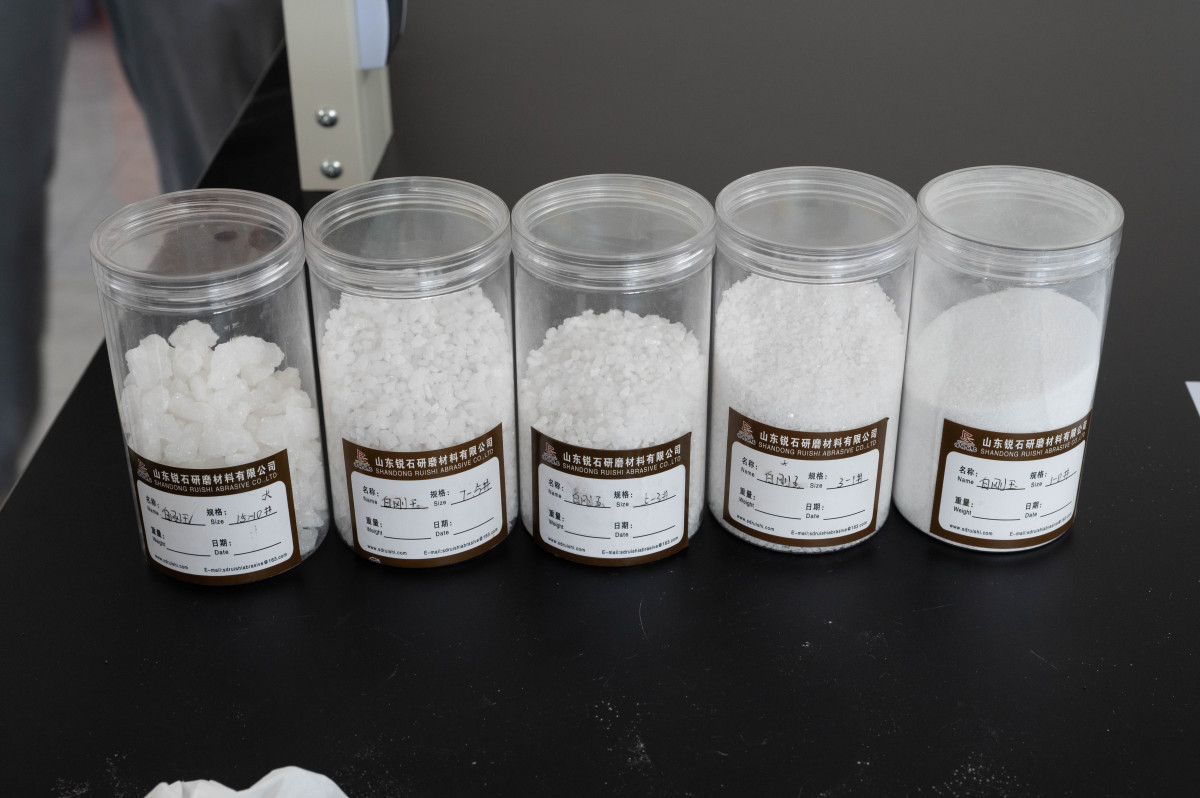
Every high-precision workshop has a quiet workhorse behind it: white fused alumina. It grinds the cutting tools that machine jet-engine alloys, lines the furnaces that melt steel, and polishes components for the semiconductor industry. Yet outside the materials world, few people know its name. This guide explains what white fused alumina (WFA) is, how it is made, what distinguishes it from brown fused alumina, how to select the right grade, and where the market stands in 2026 — written for engineers, buyers, and quality teams who specify abrasive and refractory materials.
White fused alumina is best understood as a high-purity, synthetic form of aluminum oxide produced by electric-arc fusion. Because its chemistry, grain size, and crystal structure can be controlled far more tightly than those of natural minerals, it has become the material of choice wherever consistency, cleanliness, and predictable performance are non-negotiable.
What Is White Fused Alumina?
White fused alumina — also known as white aluminum oxide, white corundum, or white electrocorundum — is a synthetic abrasive made by melting high-purity alumina (Al₂O₃) in an electric arc furnace at temperatures around 2,000 °C. The molten alumina crystallizes on cooling into corundum (α-Al₂O₃), a phase with exceptional hardness and chemical stability.
What separates WFA from natural mineral abrasives is control. Chemical composition is tightly specified — Al₂O₃ content above 99% and typically 99.2–99.8% in premium grades — while impurities such as Na₂O, SiO₂, and Fe₂O₃ are held to tight limits. Grain size is classified into narrow windows under international grit systems. As a result, every batch behaves predictably: a grinding wheel cuts at the expected rate, a refractory withstands the expected thermal load, and a polished surface comes out free of contamination. These are exactly the properties that matter in precision grinding, high-performance refractories, and advanced ceramics.
How Is White Fused Alumina Manufactured?
Producing consistent WFA is a multi-stage industrial process in which every step affects the final grain:
1. Feedstock selection. The process starts with smelter-grade alumina (also called calcined or metallurgical alumina powder), chosen for its low impurity profile. Raw-material quality largely predetermines the ceiling for final purity.
2. Electric-arc melting. The alumina is charged into a three-phase electric arc furnace and melted at roughly 2,050–2,070 °C, near the melting point of α-Al₂O₃. The controlled melt produces a clean, white ingot.
3. Controlled cooling and crystallization. Slow, uniform cooling lets the melt crystallize into coarse corundum crystals. Cooling rate influences crystal size and, in turn, the toughness and fracture behavior of the final grain.
4. Crushing. Ingots are jaw-crushed and further reduced in stages. Crushing parameters shape grain morphology — the sharp, angular edges that make WFA cut aggressively.
5. Magnetic separation. Crushing introduces trace iron. Magnetic separators remove ferromagnetic particles to keep contamination below specification.
6. Classification and sieving. Crushed grain is screened into tight particle-size windows under recognized systems — the FEPA F series (F4–F220 for macro grain, F230–F2000 for micro powder), the P series used in coated abrasives, plus JIS and ANSI equivalents. China's national standard GB/T 2479-2022 governs WA-grade chemistry .
7. Quality testing. Final lots are tested for chemical composition (Al₂O₃, Na₂O, SiO₂, Fe₂O₃), particle-size distribution, bulk density, and magnetic material content before release.
Because every stage is controlled, WFA is inherently more consistent than natural abrasives — and the same discipline makes special grades possible. Low-sodium WFA, for example, holds Na₂O at or below roughly 0.15% (ultra-low grades below 0.1%), a decisive advantage in refractory and ceramic applications where sodium weakens high-temperature performance.
Key Properties of White Fused Alumina
Chemical purity
Standard WFA contains 99% or more Al₂O₃; premium and low-sodium grades reach 99.5–99.8%. Na₂O is typically controlled below 0.4% in standard grades and far lower in low-sodium variants; Fe₂O₃ and SiO₂ are held near 0.05% and 0.1% respectively in high-purity product. Low impurity levels mean less risk of contaminating workpieces during grinding, or degrading ceramic and refractory bodies during high-temperature service — and the bright white color is a quick visual check of that purity. Purity also underpins thermal stability: with a melting point around 2,070 °C and refractoriness typically above 2,000 °C, low-impurity WFA keeps its structure under intense heat and resists thermal shock and attack from molten metals, slags, and process atmospheres.
Grain sharpness
Sharpness is what makes WFA cut — and it comes from the grain itself. WFA sits at 9 on the Mohs scale, just below diamond and silicon carbide, with Vickers hardness in the range of 2,000–2,200 HV [7]. Its angular, sharp-edged grains bite efficiently into hardened steel, stainless steel, and tool alloys. Because the grains are designed with controlled friability, they fracture progressively during grinding, constantly exposing fresh cutting edges. This self-sharpening behavior keeps material-removal rates stable and produces a better surface finish than a grain that dulls instead of fracturing.
Bulk density
Real density runs 3.93–3.97 g/cm³ and bulk density roughly 1.75–1.95 g/cm³ depending on grit [6][7]. These figures directly influence how much abrasive fits in a grinding wheel formulation, how densely a refractory castable packs, and how blasting media meters through a nozzle. Consistent bulk density from lot to lot also keeps process dosing stable — which is why it appears on every serious certificate of analysis.
Magnetic material control
Crushing naturally introduces fine iron particles into the grain, so a mature WFA line removes them with magnetic separation and verifies the result on every lot. Magnetic material content matters far more than most buyers assume: residual iron can stain stainless steel during grinding, create pitting on polished optical and semiconductor surfaces, and degrade the dielectric behavior of electronic ceramics. When an application is contamination-sensitive, ask the supplier for the magnetic content limit and how it is tested.
White Fused Alumina vs. Brown Fused Alumina
The most common comparison in the industry is WFA versus brown fused alumina (BFA). Both are corundum-family abrasives made in arc furnaces, but they start from different feedstocks and are engineered for different jobs.
Table 1. White fused alumina vs brown fused alumina at a glance
In practice, the choice is a purity-versus-toughness trade-off. If your process demands surface quality, dimensional precision, or freedom from contamination — a mirror finish on a bearing race, a clean blast profile on aerospace aluminum, a white aggregate in a high-grade castable — WFA is the right call. If the priority is removing material as fast and cheaply as possible, BFA's toughness and price usually win. Many plants keep both in stock and route jobs by requirement.
White Fused Alumina Applications
WFA earns its place in four core fields — grinding wheels, refractories, advanced ceramics, and precision semiconductor applications — and it is also a widely used blasting and surface-preparation media wherever low contamination is a requirement.
Grinding Wheel Manufacturing
WFA is one of the most important abrasive grains in grinding wheel manufacturing. Wheel makers use it in vitrified and resin-bonded wheels, cut-off wheels, mounted points and sharpening stones, as well as coated belts and discs. Its sharp, self-sharpening grain cuts stainless steel, alloy and tool steels and precision components with a cool, consistent action — which translates into predictable wheel life, a lower risk of burn, and a better surface finish. In tool rooms, WFA wheels are the standard choice for sharpening HSS and carbide tooling. Grit selection follows the job: coarser F46–F80 for stock removal, F100–F220 for finishing, and micro sizes for the finest edges.
Refractory Industry
In the refractory industry, WFA is a high-purity aggregate and filler for shaped products and monolithics — alumina bricks, kiln furniture, castables, ramming mixes and gunning materials used in steel, cement, glass, aluminum and petrochemical furnaces. Its refractoriness (typically above 2,000 °C), thermal-shock resistance and low impurity content help linings survive aggressive thermal and chemical service, while the bright white grain makes contamination easy to spot in a mix. Low-sodium WFA is especially prized here: sodium acts as a flux that lowers service temperature, so controlling it extends campaign life.
Advanced Ceramics
High-purity WFA supplies a stable, reproducible alumina source for structural and engineering ceramics, wear parts, grinding media, and electronic-ceramic components. Where products must resist wear, corrosion and heat — pump seals, wear liners, ceramic substrates — WFA's controlled chemistry supports consistent sintering and predictable finished properties.
Semiconductor & Precision Applications
At the fine end of the scale, ultra-pure WFA micro-powders — grains from a few microns to tens of microns — are the workhorse media for lapping and polishing semiconductor wafers, optical glass, ceramics and precision automotive components, where mirror finishes, scratch control and zero contamination are non-negotiable. The purity story is decisive here: high Al₂O₃ and strictly controlled Na₂O, Fe₂O₃ and magnetic content prevent surface damage and ionic contamination on wafers and optics. The same material class supports abrasive waterjet cutting and precision finishing of EV and aerospace components.
Grades, Standards & Quality Control
WFA is specified by two families of parameters: chemistry and grain size.
Chemistry. The Chinese national standard GB/T 2479-2022 sets the composition limits for WA (white alumina) abrasive grades, requiring Al₂O₃ of at least 99.2% across the common grit ranges and limiting Na₂O and other impurities by grit size. Premium product lines go further: typical high-purity WFA delivers Al₂O₃ ≥99.5%, Fe₂O₃ ≤0.05%, SiO₂ ≤0.1%, and Na₂O ≤0.35% , while low-sodium grades hold Na₂O at ≤0.15% or lower.
Grain size. Macro grit follows the FEPA F series (F4–F220), the P series for coated abrasives (P12–P220), and JIS/ANSI equivalents; micro powders follow F230–F2000 and the corresponding JIS and ANSI micropowder scales. Grain size dictates performance: coarse F16–F60 for heavy stock removal and blast cleaning; F80–F220 for general grinding and finishing; F230 and finer for lapping and polishing.
Quality control. Reliable suppliers release every lot with a certificate of analysis covering chemical composition (XRF), particle-size distribution (sieve and laser methods), bulk density, magnetic material content, and grain-shape inspection. When sourcing WFA, ask for the certificate of analysis and, for critical applications, a sample for in-process trials.
How to Select a Reliable White Fused Alumina Supplier?
The right grade is only half the equation — the right supplier is what makes every lot deliver it. When evaluating WFA suppliers, buyers should look at five things:
Production capability. Look for a manufacturer with dedicated electric-arc furnace capacity and integrated crushing, magnetic separation and classification lines. A supplier that controls the process from alumina feedstock to the finished bag can guarantee consistency in a way a trading house cannot. China is one of the world's largest fused alumina production hubs, and a producer with real manufacturing experience there understands raw material sourcing and process control from the inside.
Quality control. Ask for a certificate of analysis on every lot: chemical composition (Al₂O₃, Na₂O, SiO₂, Fe₂O₃), particle-size distribution, bulk density and magnetic material content. Confirm that testing follows recognized standards such as GB/T 2479-2022 and FEPA/ISO grit methods, and that rejects and re-tests are documented rather than quietly re-blended.
Chemical consistency. A single good lot is not a supplier. Check lot-to-lot variation over time: tighter impurity windows, especially Na₂O, mean more stable grinding performance, longer refractory life and fewer surprises in ceramic sintering. Low-sodium capability is a useful benchmark of process maturity.
Customized grades. Real applications rarely match a catalogue. The most valuable suppliers adjust grit distribution, chemical limits, surface treatment and packaging to the customer's process — and, when no existing grade fits, develop a new one. That R&D capability is the difference between buying a material and building a solution.
Technical support. Application engineers who understand grinding, refractory and ceramic processes help you specify correctly, run trials, and adjust when your process changes. Export experience also matters: suppliers who routinely serve different markets understand regional standards, documentation and logistics requirements.
The most reliable way to evaluate a supplier is to ask for samples and run your own trials — grinding wheels can be tested for cut rate and finish, castables for flow and strength, micro-powders for particle-size distribution. A supplier that welcomes testing is usually a supplier worth keeping.
White Fused Alumina Market Outlook 2026
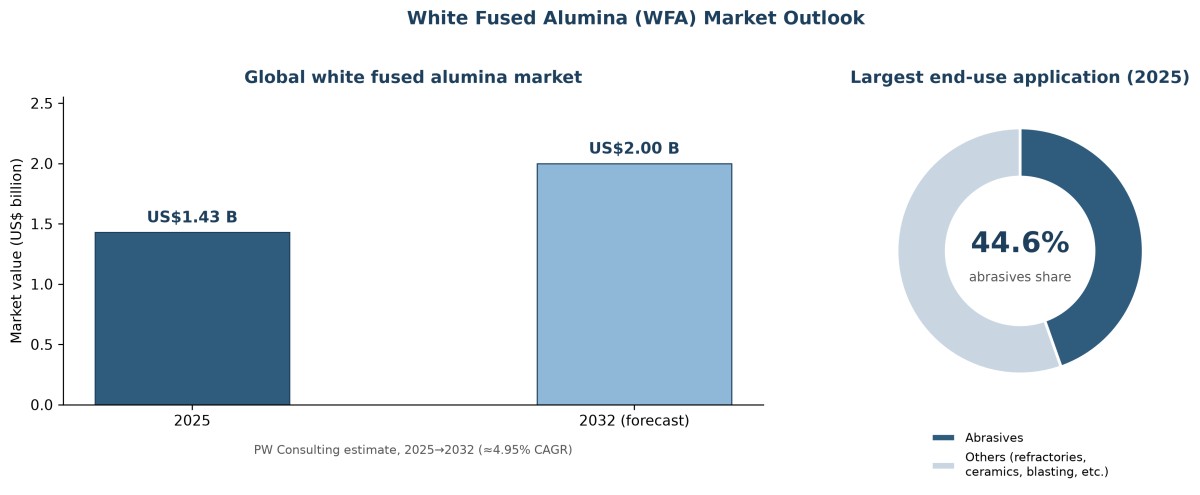
Industry research values the global WFA market at roughly US$1.4–1.8 billion in 2025, with projections pointing to continued steady growth through the early 2030s. PW Consulting estimated 2025 at US$1.43 billion, growing to about US$2.0 billion by 2032 (about 4.95% CAGR) ; Dataintelo's broader scope put 2025 at US$1.82 billion and forecasts US$2.94 billion by 2034 (5.5% CAGR). Estimates differ by scope and coverage, but the direction is consistent: demand for high-purity abrasive and refractory materials keeps expanding.
Structurally, abrasives remain the largest end-use, capturing close to 45% of global demand, and Asia Pacific is the biggest regional market — roughly 45–55% of world demand depending on the study — with China as the largest producer and consumer. Growth is supported by precision manufacturing, EV and battery supply chains, semiconductor and electronics manufacturing, aerospace finishing, and the modernization of high-temperature industrial processes. On cost, WFA carries a 30–50% price premium over BFA, a gap justified by feedstock purity and processing.
White Fused Alumina FAQ
Q1. What is white fused alumina used for? White fused alumina is used as an abrasive in grinding wheels, coated abrasives, and blasting media, and as a high-purity aggregate in refractories and advanced ceramics. It is the material of choice wherever purity, hardness, and consistency matter.
Q2. What is the difference between white and brown fused alumina? White fused alumina is made from high-purity alumina and contains ≥99% Al₂O₃; it is whiter, sharper, more friable (self-sharpening), and more expensive. Brown fused alumina is made from bauxite (94.5–97.5% Al₂O₃), is tougher and cheaper, and suits heavy-duty grinding and blasting.
Q3. Is white fused alumina the same as white aluminum oxide? Yes. White fused alumina (WFA), white aluminum oxide, white corundum, and white electrocorundum are different names for the same fused α-Al₂O₃ abrasive.
Q4. Can white fused alumina be used to make grinding wheels? Yes. WFA is a standard abrasive in vitrified and resin-bonded wheels, cut-off wheels, and coated abrasives, especially for stainless steel, alloy steels, tool steels, and precision parts.
Q5. What does low-sodium white fused alumina mean? Low-sodium WFA is a grade with Na₂O reduced to roughly 0.15% or below (ultra-low grades below 0.1%). It offers better high-temperature performance and is preferred for premium refractories and advanced ceramics.
Q6. Which grit size should I choose for blasting? As a rule of thumb, F16–F60 for aggressive cleaning and coating removal, F80–F120 for general surface preparation, F150–F220 for finer finishes, and micro powders for polishing. Confirm with a trial on your substrate.
Q7. Is white fused alumina suitable for refractory applications? Yes. Its refractoriness (typically above 2,000 °C), thermal-shock resistance, and low impurity content make it a preferred aggregate for shaped and monolithic refractories, kiln furniture, and castables.
Q8. Can white fused alumina be customized? Yes. Reputable manufacturers can adjust chemical limits (especially Na₂O), grit distribution, bulk density, and packaging, and can develop special grades for demanding applications.
RUISHI White Fused Alumina Solutions
RUISHI is a China-based specialist in alumina-based abrasive materials, exporting white fused alumina to manufacturers of grinding tools, refractories, ceramics and advanced industrial components. Years of production and export experience have taught the team that demand differs by market and application: some customers need tight grain distribution for precision wheels, others need ultra-low sodium for refractory service, and still others need fine micro-powders for semiconductor polishing. RUISHI adapts the specification to the process, not the other way around.
Unlike standard suppliers who only provide existing grades, RUISHI works with customers to develop customized alumina abrasive materials for specific applications — when a customer's process has no ready-made grade, the team develops one, from chemistry design through trial production. The program includes multiple purity grades, for example the TW-Ⅰ high-purity micro-grain grade (Al₂O₃ ≥99.5%) and the TW-Ⅱ low-sodium grade (Al₂O₃ ≥99.7%, Na₂O ≤0.06%) , as well as customized F, P and micro-powder grit distributions.
Every delivery is backed by quality testing, certificates of analysis and application support. Contact the RUISHI team to discuss your application, request samples, or start a custom development project.
Conclusion
White fused alumina has outgrown its image as a conventional abrasive. It is now a precision material in its own right — the difference between a grinding wheel that cuts predictably and one that does not, between a refractory that lasts a campaign and one that fails early, between a ceramic part that meets specification and one that does not. By specifying the right purity, the right grit, and the right supplier, manufacturers turn a commodity input into a source of process reliability.
Get Free Quotes